|
HFM technology provides the industrial gas industry with a cost-effective and efficient
method for gas separation. Membranes separate gases by the principle of selective
permeation across the membrane wall. For polymeric membranes, the rate of permeation
of each gas is determined by its solubility in the membrane material, and the rate of
diffusion through the molecular free volume in the membrane wall. Gases that exhibit
high solubility in the membrane, and gases that are small in molecular size, permeate
faster than larger, less soluble gases. Since "Fast" gases permeate through the
membrane wall more readily than "slow" gases, the original gas mixture can be separated
into two streams. In the case of air, one stream would be NEA and the other oxygen
enriched air. HFM's are very small (on the order of a human hair) and are typically
manufactured by grouping large numbers into hollow tubes to allow as much surface
area as possible to be packaged into the smallest volume.
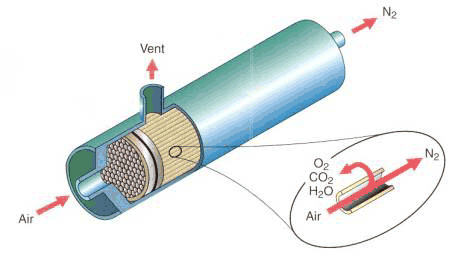
The purity of the NEA stream can be adjusted by changing the air flow rate, the
feed air temperature, or the pressure. The ability of a membrane to separate two
gases is determined by its selectivity, the ratio of permeabilities of the two gases.
The higher the selectivity, the more efficient the separation and less energy is needed
to run the system. HFM technology can be used to separate nitrogen (slow gas) from
oxygen, carbon dioxide, and water vapor (fast gases). The primary benefit of HFM gas
separation when compared to the existing methods of gas separation is simplicity of
design. Large volumes of relatively pure NEA can be generated with no moving parts
beyond those required to compress the air supply for the gas separation module. The
primary draw back of HFM gas separation technology is the limitation on purity in
nitrogen generation. Purity is generally limited to 99.9 percent nitrogen, with nitrogen
purity higher then 99 percent becoming inefficient to obtain in terms of energy cost
to generate the nitrogen. It should also be noted that systems using current HFM
technology are capable of producing about 45 percent oxygen in the permeate, or fast
gas stream.
|



