|
|
Fuel Flammability
|
Introduction |
|
 |
|
 The flammability of the fuel vapors existing
in an aircraft fuel tank ullage depends on numerous
parameters and is difficult to measure. ASTM D1655
sets forth the specifications for aviation turbine
fuels, but states only that these fuels shall consist
of refined hydrocarbons derived from crude petroleum,
natural gasoline, or blends thereof with synthetic
hydrocarbons. Thus, jet fuels typically are mixtures
of hundreds of compounds, controlled only by specifications
such as the boiling point range, flashpoint, etc., rather
than properties like the flammability limits, ignition
energy and quenching distance, which would lend
themselves more to determining fuel flammability
characteristics. At the Fire Safety Section's Pressure
Fire Modeling Facility, experiments are conducted to
determine the effects of several parameters, such as
ambient temperature and pressure, oxygen concentration
and mass loading on the fuel vapor concentrations residing
in a fuel tank ullage. It is hoped that these tests will
aid in further determining jet fuel flammability
characteristics-knowledge that can be applied to promote
the innovation of new fuel tank protection technologies.
|
|
Current Projects |
|
|
|
|
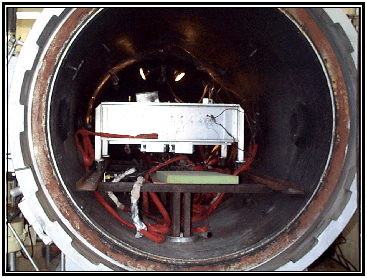
The Pressure Fire Modeling Facility is currently
being used to conducttests to determine the oxygen
concentration limit at which ignition is no longer
supported, for a given fuel-air mixture, in a fuel
tank under varying conditions. These tests are
conducted within a 9 ft3 vented tank, which is
instrumented with 13 K-type thermocouples, 2 pressure
transducers and sample lines for hydrocarbon and oxygen
concentration measurement. The thermocouples are placed
on each of the tank walls, including the ceiling and floor,
inside the liquid fuel, and in the remaining ullage space.
A bank of nitrogen bottles is used to control the oxygen
concentration while heaters placed underneath the tank
control the liquid fuel's temperature. In addition, a
vacuum pump is used to evacuate the pressure vessel to
simulate altitude. Spark initiation for the ignition
tests is achieved through a 10,000-volt transformer connected
to two tungsten electrodes with controllable gap separation
and alignment. For each test run, fuel is placed within the
test article, the pressure vessel is depressurized corresponding
to the desired altitude, nitrogen is injected to obtain the desired
oxygen concentration and the liquid fuel is heated to a predetermined
temperature. The fuel is maintained at this temperature until the
desired hydrocarbon concentration is achieved. At this point, the
ignition spark is initiated. For each altitude, fuel loading and
hydrocarbon concentration, experiments are conducted to determine
the effect of the oxygen concentration on the reactivity of the
fuel-air mixture. The aim is to determine the oxygen concentrations,
ranging from the level that prevents ignition of the fuel vapor to the
level that has no effect on the ignition, for each set of conditions.
|
|
Previous Projects |
|
|
|
|
Previous projects at the FAA Technical Center regarding
fuel flammability have included experiments to determine
the effects of the fuel mass loading and cold ambient
temperatures on the fuel vapor concentrations formed within
a fuel tank. Reports and presentations of the findings of
these projects can be found below, as well as on the
FAA Fire Safety Section's
main website. |
|
Reports |
|
|
|
| Report No. |
Title |
| DOT/FAA/AR-TN99/93 |
Cold Ambient Temperature Effects on Heated Fuel Tank Vapor Concentrations |
| DOT/FAA/AR-TN99/65 |
Mass Loading Effects on Fuel Vapor Concentration in an Aircraft Fuel Tank Ullage |
| DOT/FAA/AR-98/26 |
A Review of the Flammability Hazard of Jet Fuel Vapor in Civil Transport Aircraft Tanks |
|
|
Presentations |
|
|
|
|
Additional Information |
|
|
|
LAST UPDATED 10/30/00 |


